
Reserve Bank of India (RBI) Governor Sanjay Malhotra, and Deputy Governors Poonam Gupta, T Rabi Sankar, Swaminathan J, and S C Murmu on Friday addressed issues during the post-policy media interaction.

India's forex reserves rose by $2.7 billion to $698.19 billion during the week ended July 25, the RBI said on Friday. In the previous reporting week, the overall reserves had dropped $1.183 billion to $695.489 billion.

India's forex reserves jumped by $8 billion to an all-time high of $709 billion during the week ended January 23, the RBI said on Friday.

India's forex reserves dropped by $9.32 billion to $688.87 billion for the week ended August 1 in one of the highest declines in the recent past, the RBI data showed on Friday. The overall reserves rose by $2.7 billion to $698.19 billion in the previous reporting week.

Public sector banks have written off loans worth Rs 6.15 lakh crore in the last five and a half years, Parliament was informed on Monday.

The high-value Rs 2000 notes worth Rs 5,884 crore are still in circulation, according to official data released on Wednesday.

Sensex plunges over 1,400 points and Nifty slips near 22,250 amid Trump's Iran threat, rising crude oil prices, and FII selling. Here are the key reasons behind today's market crash.
Indian equities on Dalal Street saw volatility as global market trends and fresh tariff concerns linked to Donald Trump impacted investor sentiment. Track Sensex, Nifty50 movement and key market drivers for April 2, 2026.

The Indian rupee depreciated significantly against the US dollar, reaching a new all-time low due to rising oil prices, a strong dollar, and ongoing geopolitical concerns. Domestic equity market declines and foreign investment outflows further contributed to the rupee's weakness.

The Indian rupee depreciated by 52 paise to settle at 93.35 against the US dollar, driven by failed US-Iran peace talks, surging crude oil prices due to a potential US blockade of Iranian ports, and a global flight to the greenback. This geopolitical uncertainty is also leading to foreign capital withdrawal from domestic equities.

The Indian rupee fell to a record low against the US dollar due to rising crude oil prices, foreign institutional investor selling, and weak domestic equity market sentiment.

Unified Payments Interface (UPI) transactions reached a record high in March, driven by festivities and the financial year closure, according to the National Payments Corporation of India (NPCI).

Indian stock market benchmark indices Sensex and Nifty experienced a significant decline, driven by escalating tensions in the Middle East and rising crude oil prices.

For the time being, the RBI is done with the cuts. A cut in October, which many are still predicting, is not certain. Of course, if growth nosedives, the script will be different, expects Tamal Bandyopadhyay.

The Indian rupee, swaying through multiple headwinds, tiding over global trade disruptions and massive foreign fund outlfows, is unlikely to arrest its descent until tariff impact overhangs, notwithstanding robust domestic macroeconomic tailwinds. The Reserve Bank of India (RBI), which sees the rupee's depreciation as a silver bullet to offset the tariff shock, expects the currency to find its stable course once India reaches a trade deal with its largest trading partner, the US.

India's forex reserves dropped by $9.8 billion to $686.81 billion in the week to January 2, the Reserve Bank of India (RBI) said on Friday.

The Indian rupee weakened against the US dollar due to rising crude oil prices, geopolitical tensions in the Middle East, and foreign fund outflows.

OTP scams accounted for over one-fourth of all cyber frauds.

Using a trading terminal is not suitable for all market participants. Before market participants start using a trading terminal, it is important for them to know who really needs a trading terminal and what they can do with it. Here, we will explore who should actually use a trading terminal.

A new report indicates that UPI has become the dominant payment method for lenders, accounting for over 90% of transactions. The report also highlights trends in investment amounts, diversification strategies, and geographic participation in peer-to-peer lending.

Many of India's fintech entities and banks have stored all their customer data in India; however, many do use foreign servers, for operations, providing services and for data analytics.

Inflation data, trading activity of foreign investors and global trends would dictate sentiment in the stock market this week, according to analysts.

Retail inflation rose to a three-month high of 1.33 per cent in December 2025 mainly due to higher prices of kitchen essentials, including vegetables and protein-rich items.
India's forex reserves jumped by another $14.36 billion to a new all-time high of $723.77 billion during the week ended January 30, the Reserve Bank said on Friday.

The easing of external commercial borrowing (ECB) norms by the Reserve Bank of India (RBI) is expected to significantly boost overseas fundraising by Indian companies, market participants said.

Indian stock markets recovered from early losses to close higher, driven by value buying in IT and banking shares and a rebound in the rupee.

In response to the panic triggered by Trump's trade policies, the RBI net sold approximately $43 billion in the second half of FY25 to curb volatility, as the rupee plunged to a low of 87.95 per dollar in February this year.

India's forex reserves jumped by $3.29 billion to $696.61 billion in the week to December 26, the RBI said on Friday. The overall kitty had increased by $4.368 billion to $693.32 billion in the previous reporting week.

Wholesale price inflation extended upward momentum for the second straight month, recording at 0.83 per cent in December 2025, driven by an uptick in prices of food, non-food articles, and manufactured items on a month-on-month basis, government data showed on Wednesday. Wholesale Price Index (WPI)-based inflation returned to positive in December, after witnessing a deflationary trend in the previous two months.

The Reserve Bank of India (RBI) has started winding down its short position in the dollar forward book, after a gap of seven months, on the back of a softening dollar, while infusing funds via open market operations (OMOs) to counter the resulting liquidity drain.

Persisting uncertainties related to the US trade policies pose downside risk to the overall demand in the Indian economy while the inflation outlook for the near term has become more benign than anticipated earlier, RBI said in its latest bulletin on Thursday. In the August bulletin, the Reserve Bank of India (RBI) also said that India's sovereign rating upgrade by S&P bodes well for capital inflows and sovereign yields, going forward.

Mint Road's proposals on banks' M&A funding are cautious even as entrants root for more elbow room, and weigh business models.
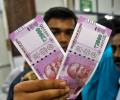
The high-value Rs 2000 notes worth Rs 5,956 crore are still in circulation, more than two years after the Reserve Bank's withdrawal of the currency notes, according to official data released on Monday. The Reserve Bank of India (RBI) had announced the withdrawal of Rs 2000 denomination banknotes from circulation on May 19, 2023.

'Every day the meter is ticking. Like a time bomb.' Shipping giants are billing Indian exporters up to $3,000 per container in war surcharges -- on cargo that sailed before the war began -- as the Strait of Hormuz shuts down.

Stock markets closed higher on Friday after the Reserve Bank of India kept its benchmark interest rate unchanged as expected and proposed allowing banks to lend to Real Estate Investment Trusts (REITs) with certain prudential safeguards to deepen the financing pool for the real estate sector.

Nearly two-thirds of external commercial borrowings (ECBs) raised so far in the ongoing financial year (2025-26/FY26) have been routed through Gujarat International Finance Tec-City (GIFT City), a sharp jump from the 36 per cent recorded in 2024-25.

Customers will qualify for compensation even if they mistakenly share the OTP.

India's forex reserves increased by $392 million to $687 billion during the week ended January 9, the Reserve Bank of India said on Friday.

The rupee appreciated 13 paise to close at 90.34 against the US dollar on Thursday, on trade deal optimism and overnight decline in commodity prices, even as the upside remained capped as investors look for more clarity on the India-US trade deal.

Fitch Ratings on Friday said persistently higher oil prices could cause India's retail inflation to rise faster than the expected gradual pace, and lead to a slowdown in economic growth in the first half of financial year 2026-27 (FY27).
